
The Power of Repetition: Martin Luther King Jr. and Rhetorical Rhythm
Creative Writing Class
Focus: Rhetorical devices, voice, persuasion, emotional impact
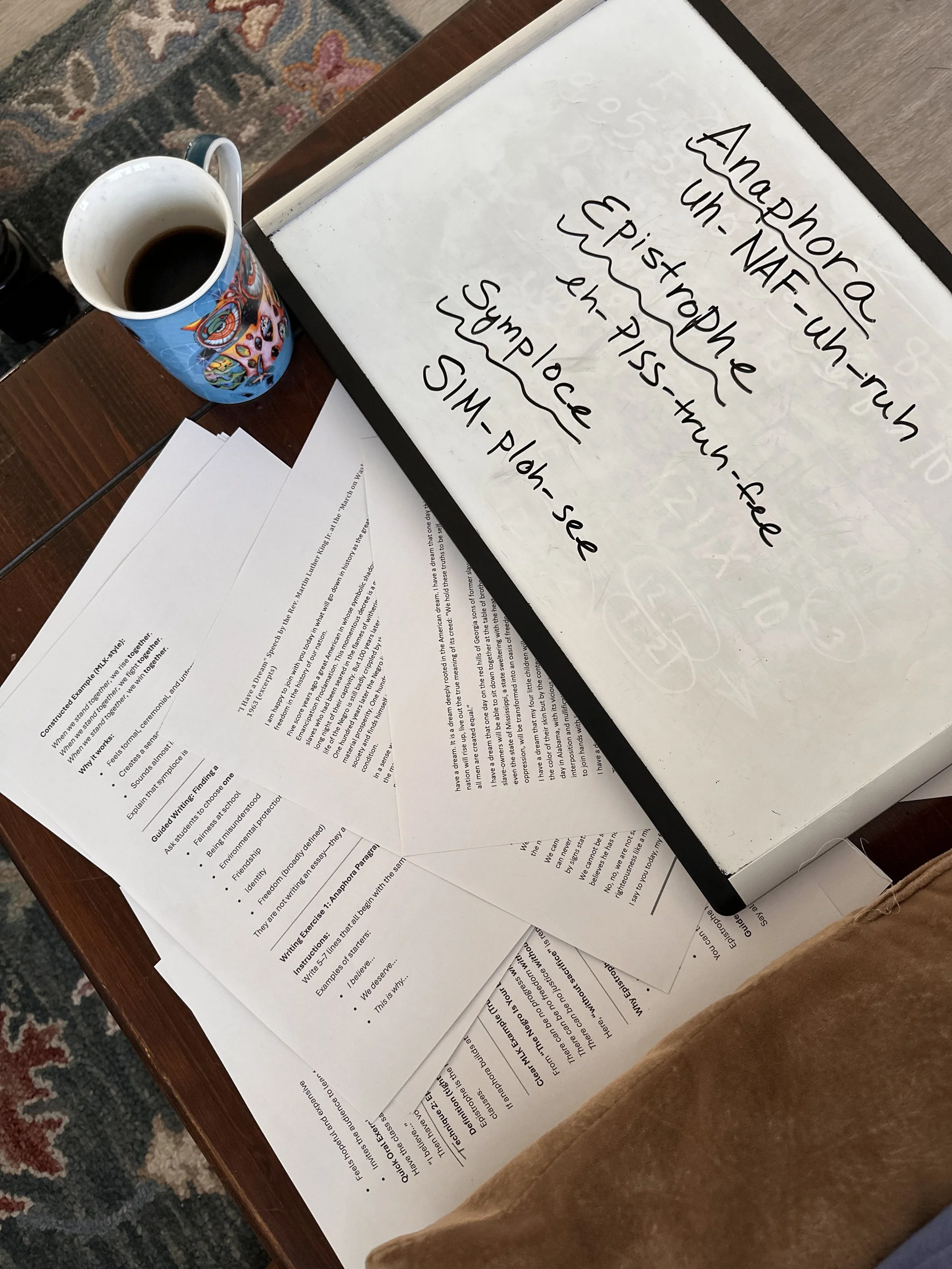
Anaphora (repetition at the beginning)
uh-NAF-uh-ruh
(a-NAF-uh-ruh)
Stress: second syllable
Rhymes with “camera” (roughly)
Tip for students: “a-NAF-uh-ruh starts again at the front”
Epistrophe (repetition at the end)
eh-PISS-truh-fee
(eh-PIS-truh-fee)
Stress: second syllable
Ends with a long “ee” sound
Tip: “epi-STRO-phe — the echo happens at the end”
Symploce (repetition at both beginning and end)
SIM-ploh-see
(SIM-ploh-see)
Stress: first syllable
The middle sounds like “flow”
Tip: “SIM-ploh-see = same at the start AND the close”
Opening Warm-Up (5 minutes)
Prompt (silent writing):
Why do people repeat themselves when something really matters?
Encourage students to think beyond “by accident.” Possible directions:
Emotion
Urgency
Memory
Music
Convincing an audience
Making words stick
Brief share-out. Introduce the idea that repetition is not redundancy—it is emphasis.
Mini-Lesson: Why MLK Still Echoes (10 minutes)
Explain that Martin Luther King Jr. was not only a leader, but a master stylist of language. His speeches were:
Rooted in sermons
Structured like music
Designed to be heard, not just read
He used repetition the way musicians use a chorus.
Technique 1: Anaphora (Beginning Repetition)
Definition:
Anaphora is the repetition of a word or phrase at the beginning of successive sentences or clauses.
Famous Example (MLK, I Have a Dream):
I have a dream that one day…
I have a dream that my four little children…
I have a dream today…
Why it works:
Builds momentum
Feels hopeful and expansive
Invites the audience to lean forward
Quick Oral Exercise:
Have the class say together:
“I believe…”
Then have volunteers finish the sentence aloud, keeping the opening phrase the same.
echnique 2: Epistrophe (Ending Repetition)
Definition (tight and student-friendly):
Epistrophe is the repetition of a word or phrase at the end of consecutive sentences or clauses.
If anaphora builds at the front, epistrophe lands at the end.
Clear MLK Example (True Epistrophe)
From “The Negro Is Your Brother” (1967):
There can be no progress without sacrifice.
There can be no freedom without sacrifice.
There can be no justice without sacrifice.
Here, “without sacrifice” is repeated exactly at the end of each sentence.
Why Epistrophe Works (Explain This Explicitly)
It pins the idea in the listener’s mind
It feels resolute, not hopeful
It creates a sense of finality and moral certainty
It sounds authoritative when spoken aloud
You can tell students:
Epistrophe feels like a gavel hitting the table.
Guided Oral Practice (30 seconds)
Say aloud together:
“Justice is impossible without truth.”
Then have students repeat with new first halves but the same ending:
Education is meaningless without truth.
Freedom collapses without truth.
They’ll feel the device working.
Writing Exercise: Epistrophe Paragraph (Revised)
Instructions:
Write 4–6 sentences that all end with the same exact phrase.
No variation. No synonyms.
Possible ending phrases:
…without justice.
…for everyone.
…right now.
…in this country.
Quick Contrast (Optional but Clarifying)
Show this non-example:
We want justice now.
We demand fairness now.
We call for change now.
Explain:
This sounds repetitive
But the repeated word is not anchored structurally
That’s emphasis — not epistrophe
Technique 3: Symploce (Beginning + Ending Repetition)
Definition:
Symploce combines anaphora and epistrophe—repeating at both the beginning and the end.
Constructed Example (MLK-style):
When we stand together, we rise together.
When we stand together, we fight together.
When we stand together, we win together.
Why it works:
Feels formal, ceremonial, and unforgettable
Creates a sense of unity
Sounds almost inevitable
Explain that symploce is harder, but extremely effective.
Guided Writing: Finding a Cause (10 minutes)
Ask students to choose one thing they care deeply about, such as:
Fairness at school
Being misunderstood
Environmental protection
Friendship
Identity
Freedom (broadly defined)
They are not writing an essay—they are writing a speech moment.
Writing Exercise 1: Anaphora Paragraph (10 minutes)
Instructions:
Write 5–7 lines that all begin with the same phrase.
Examples of starters:
I believe…
We deserve…
This is why…
I am tired of…
Encourage simple language and strong feeling.
Writing Exercise 2: Epistrophe Paragraph (10 minutes)
Instructions:
Write 5 lines that all end with the same phrase.
Examples of endings:
…must change.
…matters.
…right now.
…for everyone.
Students should feel the rhythm as they write.
Optional Challenge: Symploce (5–10 minutes)
For advanced or confident writers:
Structure Template:
When we ______, we ______.
When we ______, we ______.
When we ______, we ______.
Encourage intentionality—not filler.
Sharing & Reflection (10 minutes)
Invite volunteers to read one paragraph aloud.
After each reading, ask:
Which line stayed with you?
Did the repetition change how it felt?
Did it sound stronger spoken than read?
Closing Reflection (5 minutes)
End with this idea:
Martin Luther King Jr. understood that words do more than explain.
They move, gather, and awaken people.
Exit Question (written or spoken):
Which rhetorical device felt most natural to you—and why?
Extension Ideas (Optional)
Rewrite a calm paragraph into a speech using repetition
Apply these techniques to poetry or spoken word
Analyze repetition in modern speeches, music lyrics, or sermons