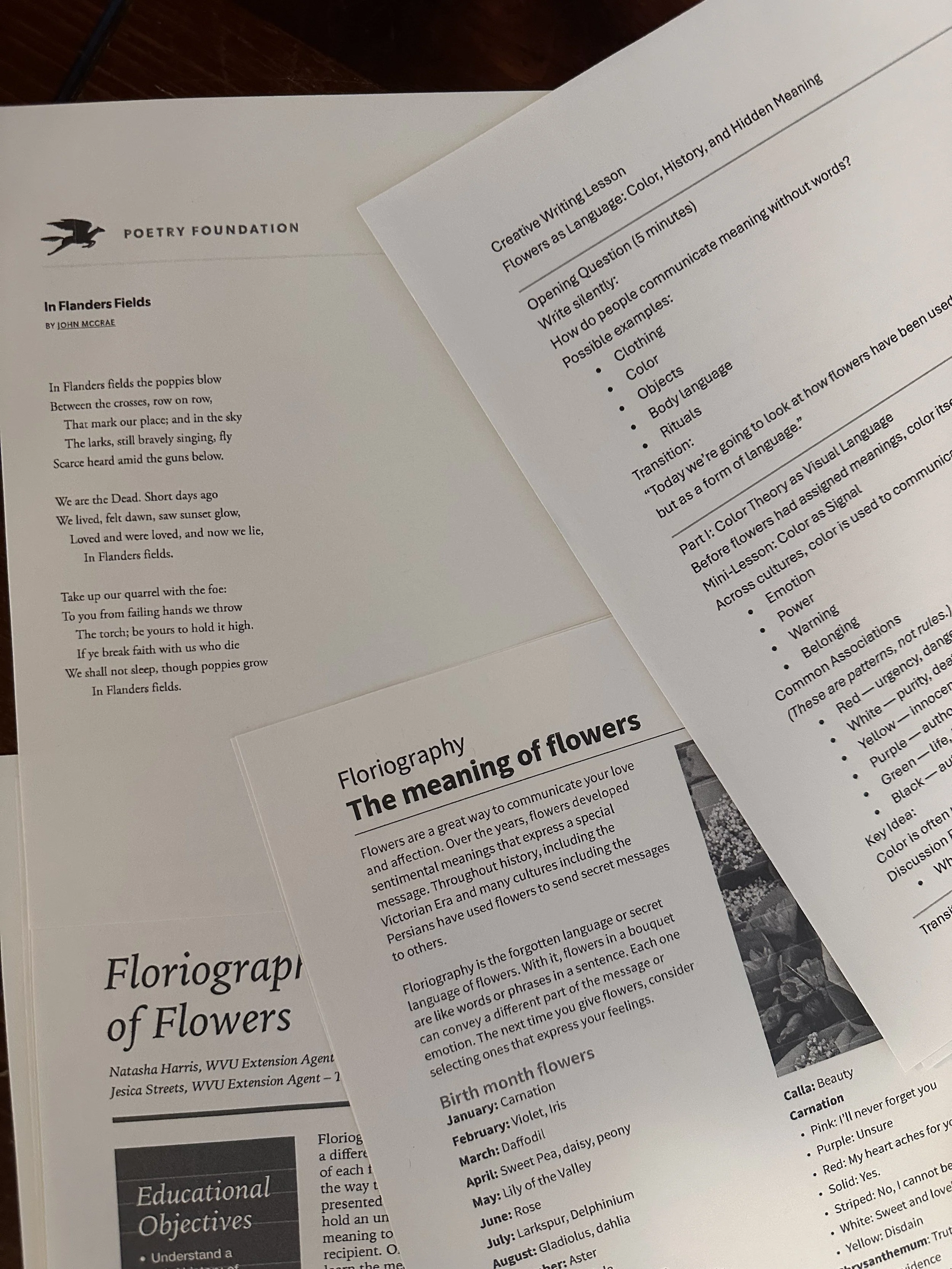
Flowers as Language: Color, History, and Hidden Meaning
Focus: Symbolism, historical context, narrative meaning
Purpose: Prepares students for later hands-on bouquet building by framing flowers as intentional communication rather than decoration
Opening Question (5 minutes)
Write silently:
How do people communicate meaning without words?
Possible examples:
Clothing
Color
Objects
Body language
Rituals
Brief share-out.
Transition:
“Today we’re going to look at how flowers have been used historically—not as decoration, but as a form of language.”
Part I: Color Theory as Visual Language (10 minutes)
Before flowers had assigned meanings, color itself carried information.
Mini-Lesson: Color as Signal
Across cultures, color is used to communicate:
Emotion
Power
Warning
Belonging
Common Associations
(These are patterns, not rules.)
Red — urgency, danger, power, blood, devotion
White — purity, death, surrender, peace
Yellow — innocence, caution, decay, jealousy
Purple — authority, rarity, spiritual power
Green — life, healing, envy, rebirth
Black — authority, mourning, secrecy
Key Idea:
Color is often understood instantly—before logic or explanation.
Discussion Prompt:
Why might color be safer or more effective than words in certain situations?
Transition
“When color combines with a living object—like a flower—it becomes even more powerful. Historically, flowers were used as tools to send messages people couldn’t say out loud.”
Part II: Modern Uses of Flowers as Symbolic Language (10 minutes)
Before we look backward, we need to recognize that flowers are still being used symbolically today, especially in spaces teenagers interact with daily.
1. Flowers as Identity & Aesthetic Branding
Examples:
Instagram imagery featuring daisies, roses, sunflowers
Floral patterns in teen fashion (Urban Outfitters, Brandy Melville, PacSun)
Album covers and merchandise using flowers as identity markers
What this communicates:
Softness
Individuality
A “curated” personality
Emotional openness
Why this works on teens:
Adolescence is an identity-formation stage
Flowers act as visual shorthand for “this is who I am”
2. Flowers as Emotional Shortcuts
Common symbolic uses:
Roses → love, intensity, drama
Wilted flowers → sadness, vulnerability
Wildflowers → freedom, authenticity
Marketing Insight:
Flowers allow brands and creators to suggest emotional depth without explanation, which works especially well on fast-scrolling platforms.
3. Flowers as Contrast (Soft + Dark)
This combination is especially popular with teens.
Examples:
Flowers paired with skulls, knives, or fire
Bright florals on dark backgrounds
Floral tattoos with barbed wire or text
What this communicates:
Complexity
Emotional contradiction
“I’m soft, but not weak”
Historical echo:
Foxglove (beauty + danger)
Poppies (beauty + death)
4. Flowers as Rebellion & Nonconformity
Examples:
Floral imagery in protest art
Flowers used ironically in streetwear
Gender-nonconforming fashion using florals
Why teens respond:
Flowers have historically been coded as “gentle” or “feminine”
Reclaiming them becomes an act of resistance
5. Flowers as Mental Health Signaling
Examples:
Flowers blooming from heads or chests in illustrations
Dead or uprooted flowers representing burnout
Healing imagery tied to growth
What this signals:
Vulnerability
Self-awareness
Emotional literacy
Literary and historical echoes:
The Secret Garden
Poppies as trauma memory
Lavender as comfort and healing
Quick Discussion Questions
Why do flowers still work as symbols in digital spaces?
When does flower imagery feel honest versus manipulative?
Can beauty make a message more dangerous?
Part III: Historical Roles of Flowers (20 minutes)
Historically, flowers were not sentimental. They were functional symbols used to communicate essential information.
1. Memory, Mourning, and Death
Rosemary
Ancient Greece & Rome: Used in funerals and worn by students to improve memory
Meaning: Remembrance and the responsibility to remember
Chrysanthemum
East Asia & Europe: Associated with death, respect, and grief
Still used almost exclusively for graves in some cultures
White Lily
Symbolized purity of the soul and peaceful rest
Common in Christian funeral traditions
Key Idea:
Flowers helped communities process death when words were insufficient.
2. Power, Status, and Authority
Laurel (Bay Laurel)
Worn by Greek champions and Roman emperors
Symbolized victory, achievement, and earned power
Lotus
Egypt & India: Symbol of rebirth and divine order
Associated with rulers and enlightenment
Fleur-de-lis
Medieval France: Symbol of monarchy and inherited authority
Key Idea:
Flowers marked who held power—and who did not.
3. Medicine, Healing, and Survival
Yarrow
Used on battlefields to stop bleeding
Associated with warriors and healers
Lavender
Used by Romans and medieval Europeans for sanitation and disease prevention
Garlic Flowers
Believed to protect against illness and evil
Key Idea:
Knowledge of plants meant survival. This knowledge was often secret and powerful.
4. Warning, Poison, and Control
Foxglove
Beautiful but toxic if misused
Affected the heart; knowledge determined life or death
Oleander
Poisonous in all forms
Used historically in assassinations
Hemlock
Used in state executions in Ancient Greece, including Socrates
Key Idea:
Flowers could be weapons. Beauty often disguised danger.
5. Rebellion, Protest, and Secrecy
Carnations
Portugal, 1974: Placed in soldiers’ guns during a peaceful revolution
Poppies
Grew on WWI battlefields
Became symbols of remembrance and protest
Roses (Sub Rosa)
Hung in meeting rooms to signal secrecy
What was said “under the rose” could not be repeated
Key Idea:
Flowers could resist authority—or protect dangerous truths.
Part IV: Literature & Quotations (10 minutes)
Famous Flower Quotes
Ralph Waldo Emerson
“The earth laughs in flowers.”Claude Monet
“I must have flowers, always, and always.”Henri Matisse
“There are always flowers for those who want to see them.”
Discussion Prompt:
How do these quotes treat flowers differently than history does?
Classic Literature Example
From The Secret Garden by Frances Hodgson Burnett:
“It was the sweetest, most mysterious-looking place anyone could imagine.”
Context:
The garden represents healing, renewal, and emotional restoration—not just beauty.
Teaching Point:
The flowers are not described individually, yet their presence transforms the characters.
Part V: Writing Exercise (25 minutes)
Option A: Flowers as Persuasion
Write a short scene, ad concept, or visual description where flowers are used to sell an idea:
Belonging
Healing
Power
Rebellion
Option B: The Bouquet That Means More Than Words
Write a short scene where a bouquet is:
Given
Left behind
Discovered
The bouquet carries a specific meaning, but no one explains it directly.
Requirements:
At least three different flowers
Each flower must serve a purpose
Meaning must be revealed through:
Reactions
Tension
Consequences
Rules:
Do not explain symbolism directly
Let the reader infer meaning
Optional Scenarios:
A bouquet left after a death
A warning disguised as a gift
A political or secret message
A healer’s bundle mistaken for decoration
Closing Reflection (5 minutes)
Respond in writing:
If someone made you a bouquet meant to communicate something important, what would you want it to say—without words?