Creative Writing Class: The Art of Persuasion
Theme: “Convince Me” (Original Class 4/7/26)
Objective
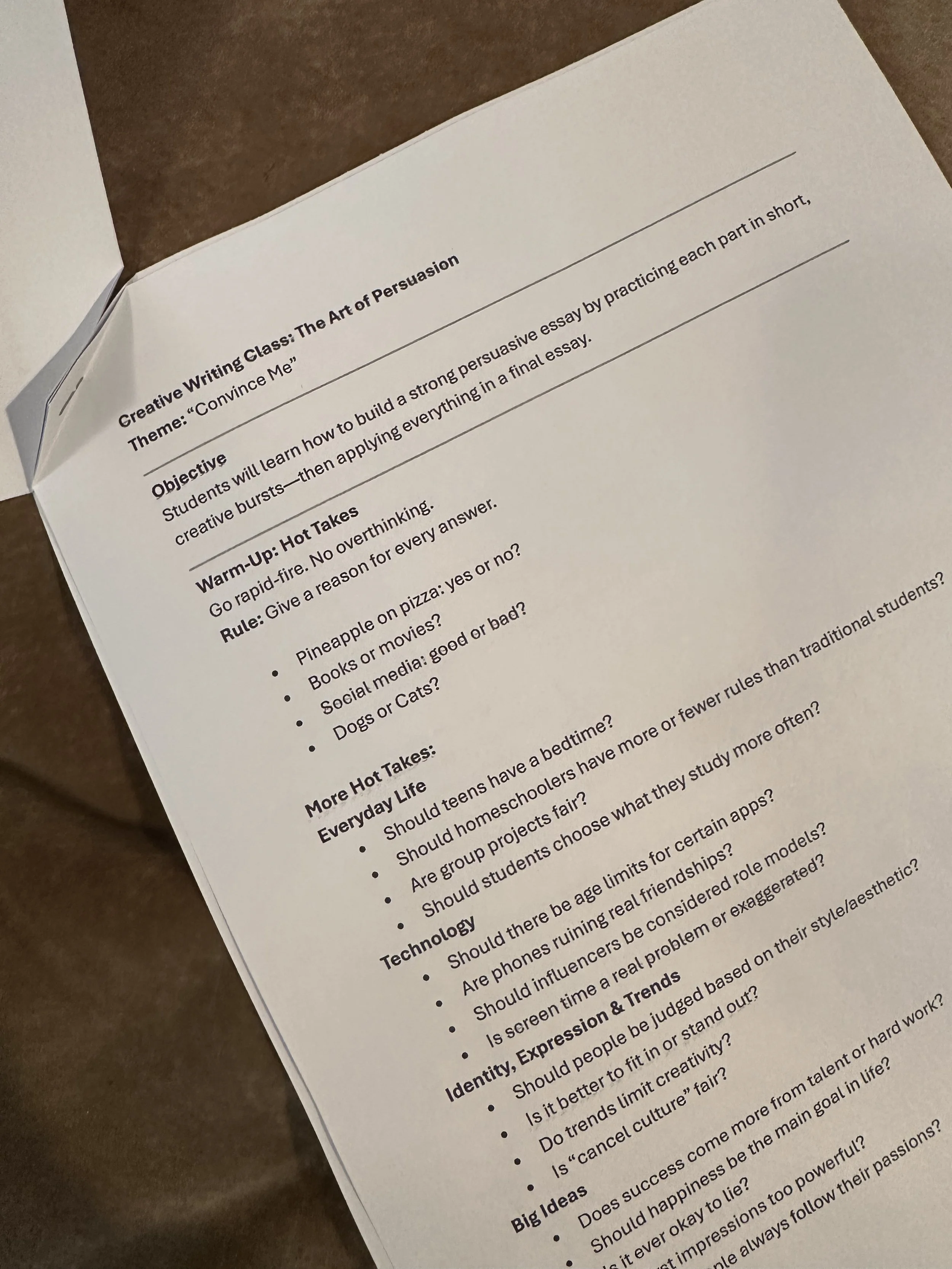
Students will learn how to build a strong persuasive essay by practicing each part in short, creative bursts—then applying everything in a final essay.
Warm-Up: Hot Takes
Go rapid-fire. No overthinking.
Rule: Give a reason for every answer.
Pineapple on pizza: yes or no?
Books or movies?
Social media: good or bad?
Dogs or Cats?
More Hot Takes:
Everyday Life
Should teens have a bedtime?
Should homeschoolers have more or fewer rules than traditional students?
Are group projects fair?
Should students choose what they study more often?
Technology
Should there be age limits for certain apps?
Are phones ruining real friendships?
Should influencers be considered role models?
Is screen time a real problem or exaggerated?
Identity, Expression & Trends
Should people be judged based on their style/aesthetic?
Is it better to fit in or stand out?
Do trends limit creativity?
Is “cancel culture” fair?
Big Ideas
Does success come more from talent or hard work?
Should happiness be the main goal in life?
Is it ever okay to lie?
Are first impressions too powerful?
Should people always follow their passions?
Real-World
Should animals be kept in zoos?
Is fast fashion harmful enough to stop buying it?
Should celebrities speak on political issues?
Is competition good or harmful for teens?
Should students learn life skills instead of some traditional school subjects?
Fun & Debate-Worthy
Are fictional villains actually misunderstood?
Is it better to read the book or watch the movie?
Should reality TV be considered “real”?
Is music today better or worse than in the past?
Should people be allowed to rewrite classic stories?
Mini Lesson: What Makes a Strong Persuasive Essay?
Keep it simple and repeatable:
Clear claim (your opinion)
Strong reasons (why)
Evidence/examples
Acknowledging the other side
Convincing conclusion
A tip (this matters more than the topic itself)
The best essays will come from topics where the author already:
has strong opinions
can think of examples quickly
enjoys arguing their side
Activity 1: Claim Game
From one of the responses to the list above, write a weak claim and then turn it into a strong claim:
Weak: “Dogs are good because they are cute.”
Strong: “Dogs make better pets than cats because they are more loyal and active companions.”
Emphasis: specific + arguable
Activity 2: Reason Brainstorm
Pick one topic.
List as many reasons as possible.
Then:
Star the BEST 2–3 reasons
Cross out weak ones
Takeaway: not all reasons are equal
Optional twist: Share and decide the most convincing reason
Activity 3: Evidence Upgrade
Take one reason and level it up:
Example:
Basic: “Homework is stressful”
Better: “Homework increases stress because students already spend 7+ hours in school and need time to rest.”
Turn simple reasons into:
examples
mini-stories
facts (even general ones)
Don’t just say it—prove it
Activity 4: The Other Side (Counterargument)
Ask:
“What would someone who disagrees say?”
Example:
“Homework helps students practice skills”
Then:
Rebuttal practice:
“While homework can help practice skills, too much of it leads to burnout and less effective learning.”
Activity 5: Hook Writing
3 hook styles:
Question: “Is homework actually helping students—or just exhausting them?”
Bold statement: “Homework is one of the biggest causes of student stress today.”
Relatable scenario: “It’s 9 PM. You’re exhausted, but you still have two hours of homework left.”
Write 2–3 different hooks for the chosen topic.
Quick Structure Review
Simple outline:
Introduction
Hook
Background
Thesis (claim + reasons)
Body Paragraphs (2–3)
Reason
Evidence
Explanation
Counterargument Paragraph
Opposing view
Rebuttal
Conclusion
Restate claim
Final thought / call to action
Final Writing
Goal: Write a full persuasive essay.
Focus:
Strong opinions
Clear structure
Voice/personality